

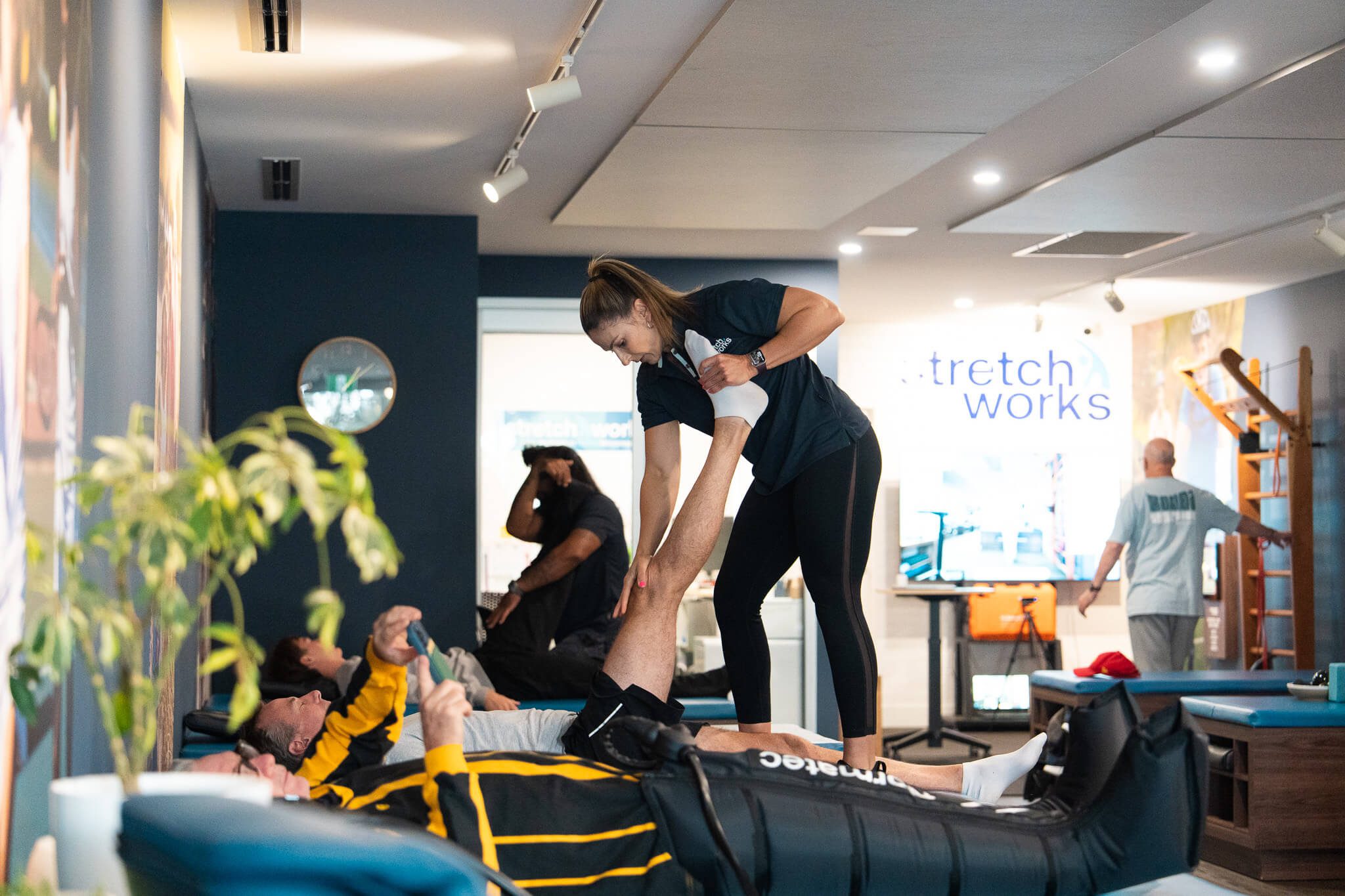
“I’m just stiff.”
It is one of the most common things we hear when someone first walks into StretchWorks.
They may struggle to reach down comfortably, turn their shoulders, hold their balance or move in a way that once felt completely natural. Over time, they begin to assume that stiffness is simply part of getting older, sitting too much or living with an old injury.
But stiffness does not always mean your body has lost the ability to move.
Sometimes, it means you have stopped trusting certain movements. Sometimes your body is protecting an area. Sometimes you have simply forgotten how to breathe, relax and allow your body to move without bracing against it.
This is where stretch therapy can offer a different experience.
At StretchWorks in Black Rock, our approach combines personalised assisted stretching, movement coaching and HumanTrak assessments. The goal is not simply to pull your arms and legs into different positions.
It is to help you understand how you move, identify where you may be restricted and support you in reconnecting with the movements that matter in your everyday life.
What is stretch therapy?
Stretch therapy is a guided approach to improving flexibility, mobility and confidence in movement.
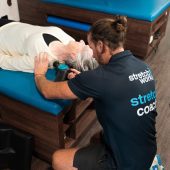
Instead of stretching alone, a trained Stretch Coach supports your body and guides you through targeted movements. This allows you to relax more fully and explore ranges of movement that may be difficult to reach on your own.
The session is personalised around your current movement, lifestyle and goals.
For one person, that might mean feeling more comfortable getting down to the floor. For someone else, it might mean improving shoulder movement for swimming, recovering more effectively after exercise or being able to play golf without feeling restricted.
Stretch therapy is often used as another way of describing professional or assisted stretching. At StretchWorks, the focus is on helping you move more freely through guided stretching, clear assessment and regular progress tracking.
Stretching is about more than being flexible
When people think about stretching, they often picture someone trying to touch their toes or holding a hamstring stretch before exercise.
But useful stretching is not about forcing your body as far as it can go.
It is about learning how your body responds to movement.
That can include:
- How easily you relax during a movement
- Whether one side moves differently from the other
- How your breathing changes when you feel restricted
- Whether another part of your body compensates
- How stable and confident you feel in different positions
- Whether your movement changes with guidance
A person may feel extremely stiff when moving alone but discover that they can move much further when their body is supported and they are given the right instructions.
That first realisation can be powerful.
Instead of thinking, “My body cannot move,” they begin to understand, “My body can move, but I may need some help learning how.”
Why stretching by yourself does not always work
Stretching at home can be useful, but many people find it difficult to remain consistent or know whether they are targeting the right area.
You may stretch the place that feels tight without understanding why it feels tight.
You may also unconsciously brace, hold your breath or avoid a movement because you expect it to feel uncomfortable. When this happens, the body can resist the stretch before you have had a chance to explore the movement properly.
During assisted stretching, your Stretch Coach can support the weight of your body, adjust your position and guide your breathing.
This gives you an opportunity to relax into the movement rather than fighting against it.
It also means the session can be adjusted in real time. If one movement does not feel right, your Stretch Coach can change the angle, reduce the range or explore a different area.
You are not expected to arrive knowing what your body needs. That is part of what the assessment and guided session are there to uncover.
We start by understanding how you move
One of the main differences at StretchWorks is that we do not begin with assumptions.
Every new client starts with a consultation and movement assessment. This gives us a clearer picture of how you are moving before we create your stretching plan.
As part of this process, we use HumanTrak, a three-dimensional movement assessment system.
HumanTrak allows us to look at areas such as:
- Posture
- Balance
- Shoulder movement
- Deep squat movement
- Trunk movement
- Movement symmetry
- General movement patterns
Your first assessment provides a baseline.
Rather than relying only on how stiff you feel that day, we can gather objective information about how your body is moving. Your Stretch Coach can then use that information alongside your goals, movement history and feedback during the session.
Depending on your frequency and needs, the assessment can be repeated every four to six weeks. This gives you a way to see whether your balance, mobility or movement patterns are changing over time.
It also helps your Stretch Coach decide where your sessions may need to be adjusted.
The assessment is not about passing or failing
There is no perfect score that every person needs to achieve.
Your results are there to give you context.
For example, someone might discover that holding a balance position for 30 seconds is more difficult than expected. Another person may see a noticeable difference between the movement of their left and right shoulder.
These findings do not define what your body can or cannot do.
They simply give you and your Stretch Coach a clearer starting point.
Many people leave their first assessment with a better understanding of their body than they had before they arrived. They can see which areas may need attention and why their personalised sessions focus on certain movements.
That insight can make the stretching process feel more purposeful.
The connection between your mind and your movement
A common pattern we see is that people arrive expecting not to move well.
They tell themselves they are too stiff, too old, too injured or simply not flexible enough.
Then the session begins.
They are guided to bend, breathe, relax and move in ways they may have avoided for months or years. Within the first five to ten minutes, many people realise their body is capable of more movement than they expected.
This does not mean every restriction disappears immediately.
It means the way they think about their movement begins to change.
When you expect a movement to hurt or feel difficult, you may tense before you even begin. When you feel supported and understand what the movement is asking you to do, it can become easier to relax.
That mind and body connection is an important part of moving with more freedom and confidence.
How is stretch therapy different from seeing a doctor?
Stretch therapy and medical care have different roles.
A doctor or orthopaedic specialist may investigate symptoms, diagnose an injury or medical condition, arrange imaging, prescribe treatment or determine whether a medical procedure is required.
StretchWorks does not diagnose or treat medical conditions.
Our work focuses on general wellness, mobility, flexibility and helping people feel more confident in everyday movement.
You should speak with an appropriate healthcare professional when you have:
- Sudden or severe pain
- A recent or acute injury
- Unexplained weakness or numbness
- Symptoms that are becoming worse
- Concerns about an existing medical condition
- Advice to seek medical care from another practitioner
Stretch therapy can often sit alongside medical care, but it should not be used as a replacement for diagnosis or treatment when medical support is required.
How is assisted stretching different from physiotherapy?
Physiotherapy is a registered healthcare profession. Physiotherapists can assess, diagnose and treat a broad range of injuries and medical conditions. They may use exercises, manual techniques, rehabilitation plans and other clinical approaches.
Assisted stretching at StretchWorks has a narrower focus.
We work with people who want to improve mobility, flexibility, movement awareness and confidence through guided stretching and ongoing movement assessment.
Someone may see a physiotherapist for an injury and later use assisted stretching as part of their broader wellness or mobility routine, where appropriate.
The two services do not need to compete. They simply perform different jobs.
How is stretch therapy different from chiropractic care?
Chiropractors are registered health practitioners who focus on musculoskeletal health, often utilising techniques such as spinal manipulation. This practice is designed to reset the nervous system to its baseline through sudden joint manipulation.
At StretchWorks, we aim to achieve this nervous system reset through muscular manipulation, reducing the muscle basal tone and allowing the joint to be manipulated more while the client has real-time awareness of how it is moving.
Our focus is on supported movement, assisted stretching, mobility and helping you better understand how your body moves.
Some people may already see a chiropractor, physiotherapist, doctor, massage therapist or other health professional. Assisted stretching can be considered an additional part of their movement and wellness routine when it is suitable for them.
StretchWorks | Your Stretch Therapy Studio
At StretchWorks, we utilise the Proprioceptive Neuromuscular Facilitation (PNF) stretching technique to enhance the therapeutic experience. This method allows the body to transition into a parasympathetic-dominant state commonly referred to as “rest and digest” even while in motion. By leveraging this neuromuscular facilitation, clients can learn to execute movements that previously required significant neurological effort with much lower levels of action potential firing.
This approach encourages the nervous system to remain calm and relaxed during activity, helping you move with greater ease and less internal resistance.
The real value is what better movement allows you to do
Improving a measurement is useful, but the number itself is rarely the reason someone comes to StretchWorks.
People want to move better because they want to live better.
They may want to:
- Play golf without struggling to pick the ball out of the hole
- Get down to the floor and stand back up comfortably
- Reach overhead without feeling restricted
- Return to swimming, cycling or hiking
- Keep up with children or grandchildren
- Recover more comfortably after training
- Feel less stiff after sitting at a desk
- Continue doing the activities that give their life energy
One of our clients described being able to retrieve a golf ball from the hole without feeling as though he needed to do the splits.
It may sound like a small thing, but these everyday moments are often what matter most.
Our goal is not flexibility for the sake of flexibility.
It is helping people reconnect with movements and activities they enjoy.
Who can benefit from stretch therapy?
You do not need to be an athlete or naturally flexible to start assisted stretching.
Stretch therapy may be suitable for:
- People who feel stiff after long periods of sitting
- Adults who have noticed their mobility changing with age
- Active people looking to support recovery and movement
- Golfers, runners, cyclists, swimmers and recreational athletes
- People who struggle to stretch effectively on their own
- People wanting a clearer understanding of their posture, balance and movement
- Anyone who wants to stay active and capable for longer
Every person starts from a different place. That is why your program should be based on your body rather than a generic stretching routine.
What happens during your first StretchWorks session?
Your first visit is designed to give both you and your Stretch Coach a clear starting point.
It includes:
1. A conversation about your goals
We begin by discussing your lifestyle, movement history and what you would like to improve.
2. A HumanTrak movement assessment
We assess key movement patterns, posture and balance to create your initial baseline.
3. A guided assisted stretching session
Your Stretch Coach takes you through a personalised full-body stretch while supporting your position, breathing and movement.
4. Feedback and a recommended direction
You leave with a clearer understanding of how your body is currently moving and which areas may benefit from additional attention.
From there, you can decide whether you would like to continue through a membership, session pack or casual stretching arrangement. You can view the available StretchWorks participation options before choosing what suits your routine.
You may not be as stiff as you think
Feeling stiff can become part of the story you tell yourself about your body.
But your current movement is not necessarily your permanent movement.
With the right support, assessment and guidance, you may discover that your body is capable of more than you expected.
Stretch therapy gives you the opportunity to slow down, understand your movement and work towards feeling more capable in the activities that matter to you.
StretchWorks was created to help people reconnect with that freedom.
Not just to move an arm or leg slightly further, but to help them return to the things they once loved doing and want to keep doing for years to come.
Looking for stretch therapy in Melbourne?
StretchWorks provides personalised assisted stretching and HumanTrak movement assessments from our studio in Black Rock, Bayside Melbourne.
Your first visit includes a consultation, mobility assessment and guided stretch designed around your body and your goals.
Explore the StretchWorks introductory session or contact the StretchWorks team to discuss your first appointment.
Frequently Asked Questions
Is stretch therapy the same as assisted stretching?
The terms are often used in a similar way. At StretchWorks, the service involves a trained Stretch Coach guiding and supporting your body through personalised stretches. The broader process also includes movement assessment, progress tracking and mobility coaching.
Do I need to be flexible before starting?
No. Many people begin assisted stretching because they currently feel stiff or restricted. Your session is adjusted to your current ability and comfort.
What does HumanTrak measure?
HumanTrak helps assess movement patterns in areas such as posture, balance, shoulder movement, squat movement, trunk movement and symmetry. StretchWorks uses the results as a baseline for planning and reviewing your personalised sessions.
How often is the HumanTrak assessment repeated?
Depending on your needs and session frequency, the assessment may be repeated every four to six weeks. This allows you and your Stretch Coach to review your progress and adjust your program.
Can stretch therapy replace physiotherapy or medical treatment?
No. StretchWorks provides a general wellness, flexibility and mobility service. It does not diagnose or treat medical conditions. Speak with a qualified healthcare professional if you have an injury, severe pain, worsening symptoms or concerns about a health condition.
Where is StretchWorks located?
StretchWorks is located at 303B Beach Road, Black Rock, Victoria. The studio supports clients from Black Rock, Beaumaris, Sandringham, Mentone, Hampton and surrounding Bayside Melbourne areas.
Neck, Shoulder and Knee Stretches Melbourne Office Workers Should Know - Stretch Works
June 29, 2026[…] Also Read: Stretch Therapy Melbourne Studio […]
Assisted Stretching for Athletes: Why Young Players Should Take Recovery Seriously - Stretch Works
August 4, 2026[…] a young athlete, that can be the difference between stretching because you know you should and stretching in a way that actually supports your […]