
“Your body isn’t failing you. It’s changing, and it deserves support.”
If you’ve been waking up stiffer than you used to, feeling aches you can’t explain, or wondering why your body suddenly feels unfamiliar, you’re not imagining it. And you’re far from alone.
At StretchWorks, many of the women who come through our Black Rock studio are in their 40s and 50s. A lot of them tell us the same thing: “I just don’t feel like myself in my body anymore”, all due to menopause.
So let’s talk about what’s actually going on, and where assisted stretching fits in.
What is menopause?
Menopause is a natural biological stage. It’s officially reached after 12 consecutive months without a period, when there’s no other medical cause. Most women reach it between 45 and 55, and the average age is around 51.
Menopause is not a single moment, though. It’s one point in a longer transition that usually happens in three stages:
Perimenopause. These are the years leading up to menopause. Ovarian function becomes less predictable, oestrogen and progesterone fluctuate, cycles become irregular, and symptoms often begin. For many women this stage lasts several years.
Menopause. The point reached after 12 months without a period.
Postmenopause. Everything after that. Oestrogen stays lower than it was during your reproductive years, and that keeps influencing several systems in the body.
This matters because most women feel the biggest changes during perimenopause, often well before they’d think to call it menopause.
Why oestrogen affects more than your cycle
Oestrogen is often thought of as a purely reproductive hormone. It isn’t. It plays a role in your bones, muscles, connective tissue, heart health, temperature regulation, sleep and mood. When it starts to fluctuate and then drops, you can feel it all over your body.
Muscles. Oestrogen helps with muscle maintenance, repair and quality. Lower oestrogen, combined with ageing and less activity, can contribute to reduced strength and slower recovery.
Joints and connective tissue. Oestrogen influences collagen, the protein that gives tendons, ligaments and other connective tissue their structure. During the transition, many women notice new aches, joint discomfort or stiffness, particularly first thing in the morning.
Bones. Oestrogen helps balance how bone is built and broken down. As levels drop, bone density can decrease, which raises the risk of osteoporosis.
Sleep, mood and recovery. Hormonal fluctuations can disrupt sleep and affect mood and energy. Poor sleep then makes everything else feel harder, including how your body recovers.
Temperature. Hot flushes and night sweats happen because oestrogen changes affect the body’s temperature control systems.
Why do I ache so much during menopause?
If you’ve ever searched this at 2am, you’re in good company. Musculoskeletal symptoms are one of the most common and least talked about parts of the menopause transition.
A 2024 review published in the journal Climacteric, estimated that more than 70% of women experience musculoskeletal symptoms during the transition from perimenopause to postmenopause. Researchers have started calling it the “musculoskeletal syndrome of menopause.”
In practice, most women describe it like this:
- A stiff neck and shoulders that never quite let go
- Hips and lower back that tighten after sitting
- Stiff knees and legs on the first steps out of bed
- A general feeling of aching all over for no clear reason
So yes, menopause can cause stiffness. And the aches you’re feeling can be real, physical and connected to the hormonal changes happening in your body.
How assisted stretching can help during menopause
We’ll be clear from the start. Assisted stretching is not a treatment for menopause. It won’t balance your hormones, and it won’t reverse the changes happening in your body.
What it can be is a supportive movement and recovery tool. It can help you stay moving comfortably and manage that feeling of muscular stiffness through perimenopause, menopause and beyond.
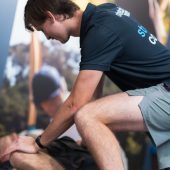
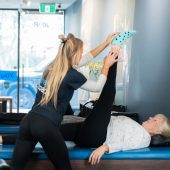
During an assisted stretching session at StretchWorks, a trained Stretch Coach supports the weight of your body, guides your positioning and guides your breathing. We use a technique called Proprioceptive Neuromuscular Facilitation (PNF). It combines gentle, controlled muscle contractions with supported stretching to help your body ease into a greater range of motion without forcing it.
For many women, the biggest difference is simply not having to do it alone. Stretching at home when you’re tired, sore and running on broken sleep often turns into bracing, rushing or skipping it altogether. Having someone else guide the movement means you can actually let go, and safely push your body to limits you wouldn’t usually achieve on your own.
What a menopause-aware stretch session looks like
Menopause changes the context of a session, not the fundamentals of safe stretching. Here’s how our Stretch Coaches adapt:
We ask how you’re feeling today. Energy, sleep and comfort can change from one day to the next during menopause, so every session starts with a check-in.
We start gently and build. Coaches begin conservatively, use controlled contractions rather than maximum effort, and increase intensity only as your body responds.
We work within comfortable range. More range of motion doesn’t automatically mean a better session. We don’t push past what feels right, and we never treat pain as something that needs to be “released.”
We adjust for poor sleep or fatigue. On a flat day, we might lighten the contractions, add more rest and focus on easy, comfortable movement.
We pause for hot flushes. If one comes on, we stop, give you time to cool down and have some water, and continue only when you’re ready.
We’re careful with bone density. If you have osteopenia or osteoporosis, we avoid aggressive end-range stretching, sudden movements and forceful twisting or bending of the spine.
Every new client at StretchWorks starts with a consultation and a movement assessment using HumanTrak, a three-dimensional movement assessment system. It gives an objective look at your posture, balance, shoulder and trunk movement, and symmetry.
During menopause, when your body can feel unpredictable, that clarity helps. Instead of a vague sense that “everything feels tight,” you get a clear starting point, and your Stretch Coach can build sessions around what your body needs right now.
Assisted stretching located in Black Rock: we’re here to help
You don’t have to manage perimenopause stiffness or menopause joint pain on your own. At StretchWorks Black Rock, our Stretch Coaches offer personalised assisted stretching and HumanTrak movement assessments from our Bayside Melbourne studio. Every session is adapted to how you feel that day.
Your first visit includes a consultation, a mobility assessment and a guided full-body stretch built around your body and your goals.
Book your introductory session or contact our friendly team with any questions.