

“Your body has done something extraordinary. Now it’s learning something new, and it’s time to take care of yourself too.”
The first months with a new baby are full of moments you’ll never forget. They’re also full of positions your body has never had to hold before. Head tipped down during feeds. Shoulders curled forward. A baby on one hip while you make a coffee with the other hand. Bending over the cot, the change table and the car seat, again and again, often on very little sleep.
If your neck, shoulders and back are feeling it, you’re not imagining it, and you’re far from alone.
So let’s talk about what’s actually changing in your body after birth, when it’s safe to start stretching, and where assisted stretching can fit into your recovery.
Your body after birth: what’s really changing
Pregnancy and birth ask a lot of your body, and it can be overwhelming soemtimes. Recovery doesn’t end at the six-week check. For many women it continues gently over the months that follow.
Your pelvis. The joints of the pelvis widen and soften during pregnancy to make room for your baby. Research suggests they take a few months to settle. One study found the joint at the front of the pelvis had returned to its usual width by around three months after birth.
Your tummy muscles. It’s very common for the two sides of the long tummy muscle to separate during pregnancy, a change known as abdominal separation or diastasis recti. A study of 300 first-time mums found 60% still had a separation at six weeks after birth, and about one in three at 12 months. This is one reason a gentle, guided approach to movement matters.
What about relaxin? You may have read that the hormone relaxin keeps your joints loose for months after birth. The research tells a different story. Relaxin levels fall back to almost pre-pregnancy levels within a few days of giving birth. That doesn’t mean your body is “back to normal” though. Your pelvis, tummy muscles and connective tissue are still recovering, which is exactly why postnatal stretching should start gently and build slowly.
Your sleep. Broken sleep doesn’t just leave you tired. Studies show that even a few nights of disrupted sleep can make the body more sensitive to pain, so everyday aches can feel bigger than they would on a full night’s rest.
The new positions your body is living in
This is the part nobody really warns you about. Caring for a newborn is physical work, and it’s repetitive. Your body adapts to the positions you spend the most time in.
Feeding. Whether you breastfeed or bottle feed, you might spend hours each day looking down at your baby with your shoulders rounded forward. In a 2023 survey of 336 breastfeeding mums, around two in three reported neck pain, upper back pain or shoulder pain. If you’ve wondered why your upper back hurts from breastfeeding, the long, repeated hold is likely part of the answer. The same survey found pain was linked to the feeding position mums used.
Carrying and rocking. Babies are often carried on one side, propped on a hip or held in one arm while the other hand does everything else. Over weeks, that lopsided load adds up through your shoulders, back and hips.
Lifting and bending. Car seats, prams, cots, baths and change tables all ask you to bend and lift, often at awkward angles and often while your tummy muscles are still recovering.
Thumbs and wrists. Pain at the base of the thumb and side of the wrist, sometimes called “mother’s wrist” (de Quervain’s tenosynovitis), is common in the months after birth. Research points to the repeated lifting and handling of a baby as a key cause.
Lower back and pelvis. Back and pelvic pain are common in pregnancy, and for some women they hang around. Most studies have found that around four in ten women with back or pelvic pain in pregnancy still had it six months after birth.
How assisted stretching can support you after birth
Assisted stretching can be a supportive part of your recovery. It’s a way to gently ease the tension that builds up from feeding, carrying and lifting, and to help your body move more comfortably as it adjusts to life with your baby.
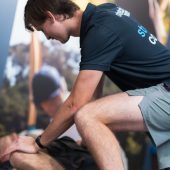
During an assisted stretching session at StretchWorks, a trained Stretch Coach supports the weight of your body, guides your positioning and guides your breathing. We use a technique called Proprioceptive Neuromuscular Facilitation (PNF), which combines gentle, controlled muscle contractions with supported stretching.
For many new mums, the biggest difference is simply having time where someone else does the work. Stretching at home rarely happens when the baby finally sleeps and the washing is piling up. In a session, you can lie back, breathe and let your body be looked after for a change.
When can I start stretching after giving birth?
Australian guidance encourages gentle walking and pelvic floor exercises as soon as you feel comfortable after birth. A gradual return to more structured activity is generally considered safe after your six-week postnatal check.
For assisted stretching, we ask that you:
- Wait until after your six-week postnatal check and have been cleared for exercise by your GP, obstetrician or midwife
- Tell us how your baby was born. If you had a caesarean birth, your scar needs time to regain strength, and we’ll work around it carefully
- Let us know about any abdominal separation or pelvic floor concerns. Many Australian health services suggest a check with a pelvic health physiotherapist after birth, and assisted stretching works alongside that care, not instead of it
If you’re unsure, check with your healthcare provider first. There’s no rush. Your body will still be here when you’re ready.
How we can help new mums
Assisted stretching gives your body some care while it adjusts to life with a baby. Here’s what it can offer:
- Relief where you carry the load. Your Stretch Coach focuses on the areas that take the strain of feeding and carrying: neck, shoulders, upper back, chest and forearms, along with your hips and lower back.
- Gentle, guided movement. Sessions start gently and stay within a comfortable range, so you can ease tension without forcing anything while your body recovers.
- Moving more freely. Supported stretching can help improve your range of motion, so everyday tasks like lifting the car seat or reaching into the cot feel easier.
- Time that’s just for you. You lie back and breathe while someone else does the work. For many new mums, it’s the only part of the week that’s all about them.
- Sessions that fit your life. Every session is adapted to how you feel that day, and we work around feeds and use positions that feel comfortable.
You’ve spent months looking after your baby. Your body deserves some care too. At StretchWorks Black Rock, our Stretch Coaches offer personalised assisted stretching and HumanTrak movement assessments from our Bayside Melbourne studio, with every session adapted to how you feel that day.
Your first visit includes a consultation, a mobility assessment and a guided full-body stretch built around your body and your goals.
Book your introductory session or contact our friendly team with any questions.